

Designing an operational command center for home concierge agents
40%
Call Handling Time
85%
First Call Resolution


Prologue
MoveEasy is a US-based home management concierge platform helping homeowners manage moves, utilities, insurance, and home services.
As a UX designer at the startup, I owned the end-to-end process for building the concierge agent dashboard.
Client seeks help with electricity, wifi, docs etc. while home shifting
+
Concierge sorts out all tasks with third party vendors
=
Client has smoother home shift experience
Problem space
Problem
Behind the scenes?
Concierge agents handle everything.
The existing system was chaotic and inefficient. A move from one home to another include all of these:

Calendars
Vendor Portal
Notes
Emails
Spreadsheets

This caused:
High average handling time (20 mins) | Missed details | Manual follow-ups | Fragmented client history
How might we give agents everything they need in one contextual workspace during a live call?
Research
I collaborated with a US-based research team.
We shadowed concierge agents during live calls & workflows,
Collected qualitative feedback from agents on usability, confusion, and bottlenecks,
Audited existing UX flows, data entry screens, and customer dashboards.
Some snapshots of research files, including service blueprints, journey mapping, conversational flows etc. -(NDA protected)

Biggest insight?
👎🏻
Agents don’t need another tool
👍🏻
They need an orchestrated system
Cognitive load was the real bottleneck. They needed all context in one place, guided conversation structure, embedded actions.
The Solution - A Unified Agent Command Center
The 3 main goals of the project were to Facilitate easier communication, Automate every step, Bring third-party services in one roof.
The goal was to embed actions inside conversation context, surface information dynamically, and centralize activity history in one operational command center.
Instead of designing another dashboard, we restructured the workflow architecture itself.
#1
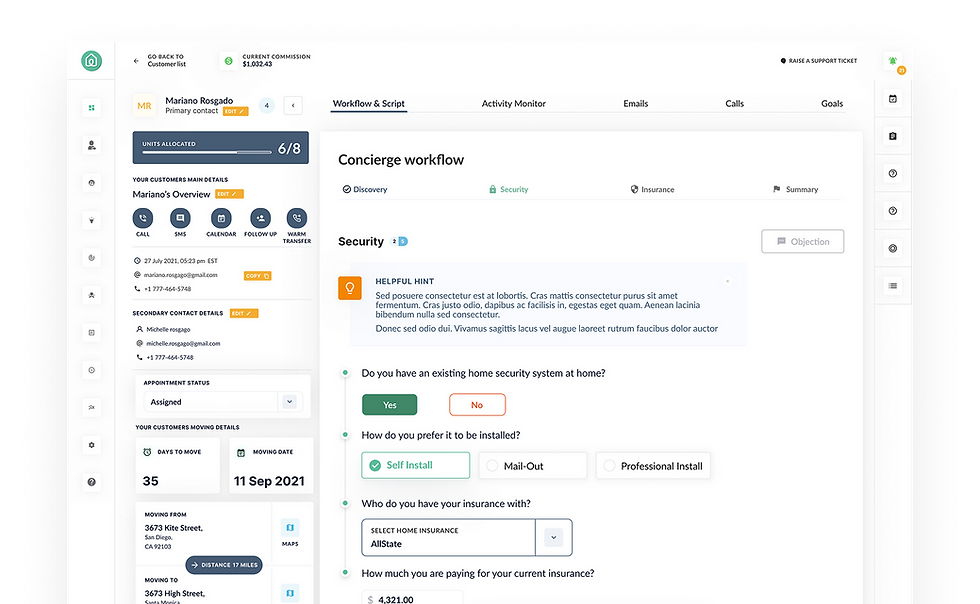
Script-led Conversation & Booking
Instead of agents referencing a script elsewhere, the script became the workflow.
The interface:
-
Displays conversation prompts
-
Allows booking inside the script
-
Captures structured notes in context
-
Minimizes flow breaks
Agents could talk and execute simultaneously.
No tab hopping.
This directly reduced handling time.
#2
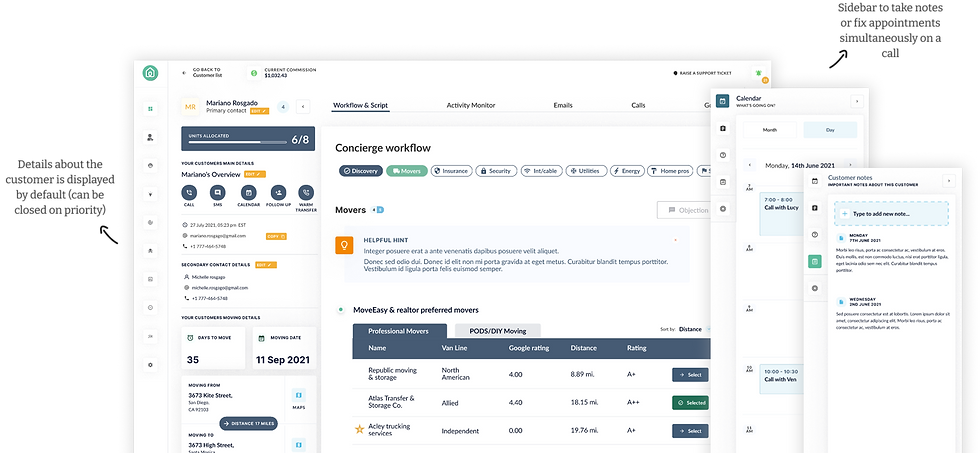
Dynamic Sidebar
A dynamic sidebar surfaced relevant client information, contextual shortcuts, and quick access to scheduling and notes. Instead of searching for information, agents received it when needed.
#3
Concierge Calendar
Calendar functionality was integrated directly into the workflow, allowing meetings to be scheduled or rescheduled in real time without leaving the active call view.

#4
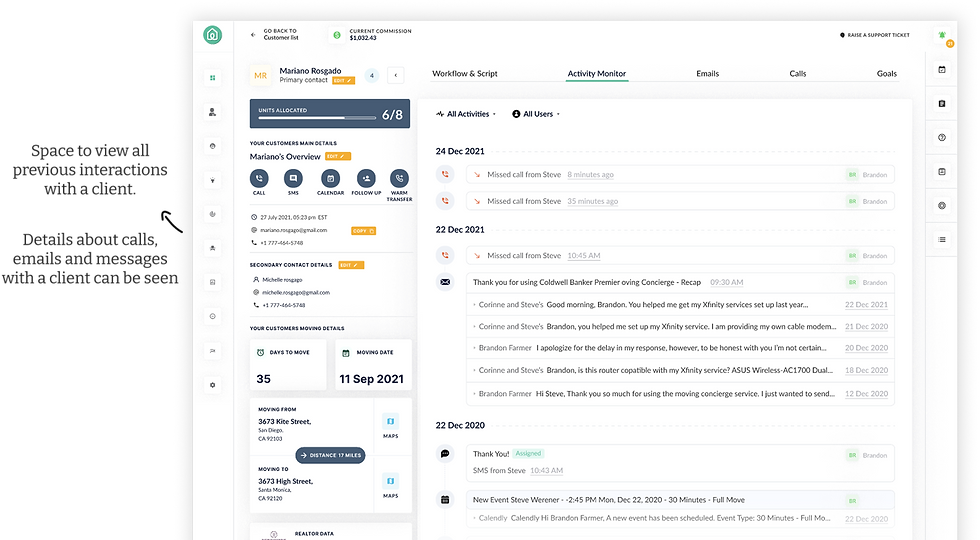
Activity Log
An activity monitor consolidated calls, emails, messages, and previous interactions into a structured timeline. Context reconstruction was no longer manual.
Design System & Scalability
This was not a visual redesign. It was a reduction of operational friction.
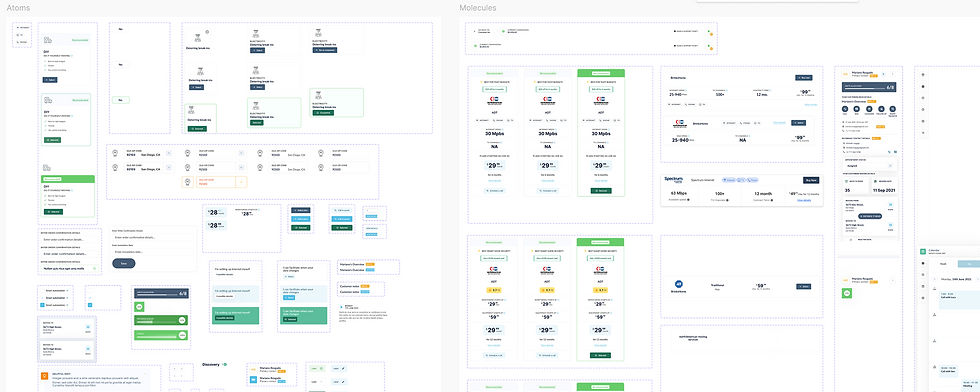
Given the number of service modules and booking patterns, we maintained a scalable component library built on atomic design principles.
Impact
With agents completing double the operational work in nearly half the time, homeowner onboarding accelerated and overall business growth doubled.
Reduced follow-up dependency
Reduced from 20 minutes to 12 minutes
Average Handling Time (AHT)
85%
First Call Resolution (FCR)
1500%
Agent Enrollment
10–15/month to 250/month following launch